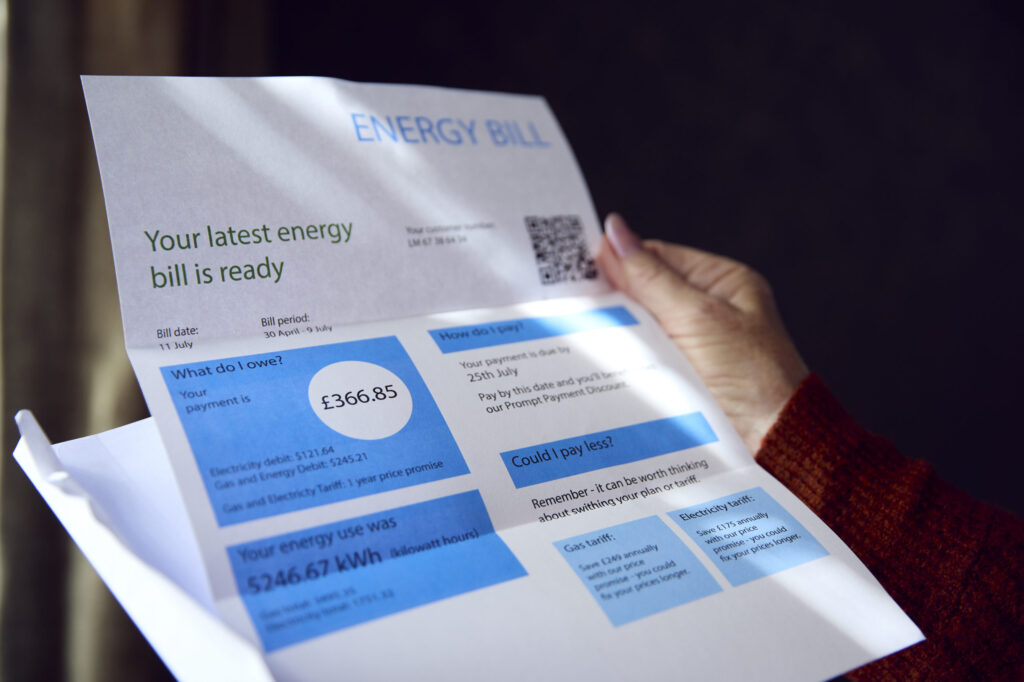
Introduction: Deciphering Your Water Bill
Your water bill might seem simpler than energy bills because you don’t choose your supplier, but it still has important details to understand. One of the biggest differences is whether your home has a water meter or not – this significantly affects how you are charged. This guide will help you understand the components of your water bill, whether it’s metered or unmetered, and what to look out for.
Step 1: Find Key Information on Your Bill
Water bills usually come monthly, quarterly, or even twice a year. They’ll arrive by post or email. First, locate these essential details:
Account Number / Customer Reference Number: Your unique ID with your water company (e.g., Yorkshire Water).
Bill Date: The date the bill was issued.
Payment Due Date: The deadline for your payment. Make sure to note this down.
Amount Due / Balance to Pay: The total amount of money you need to pay for this billing period.
Billing Period: The start and end dates covered by this bill.
Step 2: Determine if Your Bill is Metered or Unmetered
This is the most crucial distinction for your water bill.
Option A: Metered Bill (You Pay for What You Use)
How it works: If your home has a water meter, you are charged based on the actual amount of water you use. The meter records your consumption in cubic metres (m³).
How to tell: Your bill will clearly show meter readings (current and previous) and your usage in cubic metres. There will be a “volume” or “consumption” charge.
Charges you’ll see:
Water Volume Charge (p/m³): This is the price you pay for each cubic metre of fresh water supplied to your home.
Example: If the charge is 200p (or £2.00) per cubic metre and you used 10 m³, this part of your bill would be £20.00.
Wastewater Volume Charge (p/m³): You are also charged for the water that goes down your drains (wastewater/sewerage). This is usually based on the same amount of water supplied to your home, as most of the water you use ends up as wastewater. This is also charged per cubic metre.
Standing Charge (Water): A fixed daily or annual charge for the cost of providing the water supply to your property, regardless of usage.
Standing Charge (Wastewater/Sewerage): A fixed daily or annual charge for the cost of collecting and treating your wastewater.
Surface Water Drainage Charge: A charge for draining rainwater from your property (roofs, driveways) into the public sewers. This is usually a fixed annual charge.
VAT: Water bills for domestic use are generally VAT exempt in the UK, but for non-domestic use (e.g., if you run a business from home) or for certain services, VAT might apply. Check your bill.
Benefits of Metered: You only pay for what you use, so if you’re careful with water, you can save money. This is often cheaper for single people or small households.
What to look out for: Ensure the meter readings on your bill match what you expect or what you provided. If it’s an “estimated” reading, provide an actual one to ensure accuracy.
Option B: Unmetered Bill (Fixed Charge)
How it works: If your home doesn’t have a water meter, you pay a fixed annual charge regardless of how much water you use. This charge is usually based on your property’s “rateable value” (an old valuation of the property’s rental value from before 1990) or sometimes simply a fixed charge per property.
How to tell: Your bill will not show meter readings or usage in cubic metres. It will simply state a fixed annual charge.
Charges you’ll see:
Water Service Charge: A fixed annual charge for your fresh water supply.
Wastewater / Sewerage Service Charge: A fixed annual charge for taking away your used water and treating it.
Surface Water Drainage Charge: A fixed annual charge for draining rainwater from your property.
VAT: Again, generally VAT exempt for domestic use.
Benefits of Unmetered: You know exactly what you’ll pay each year, making it easier to budget. This can be cheaper for larger households that use a lot of water.
What to look out for: If you are a single person or a small household in an unmetered property, you might be able to save money by requesting a meter. Water companies usually install meters for free. You also generally have 24 months to switch back to unmetered if you find it’s more expensive (check with your provider, as rules can vary slightly).
Step 3: Other Important Information on Your Bill
Payment Methods: Your bill will clearly state how you can pay (Direct Debit, online, phone, payment card at Post Office/PayPoint).
Contact Details: Phone numbers for customer service, emergencies (like a burst pipe in the street), and often a link to their website.
Social Tariffs / Support Schemes: Water companies offer specific financial assistance for customers on low incomes or certain benefits. Your bill or their website will have information about these schemes (e.g., Yorkshire Water’s “WaterSupport” or “WaterSure” schemes). These can significantly reduce your bill.
Step 4: What to Do Once You’ve Understood Your Bill
Check for Accuracy: Always verify that your name and address are correct. If metered, check the meter readings. If unmetered, ensure the billing period is right.
Consider a Meter (if Unmetered): If you’re on an unmetered bill and you’re a single person or a small household, consider using a water meter calculator (many water company websites or the Consumer Council for Water have them) to see if you could save money by getting a meter installed.
Pay Your Bill: Make sure to pay by the due date!
Keep Records: Store all your water bills and payment confirmations in a safe place.
Reach Out for Support:
Your Personal Advisor (PA): Your PA is a vital resource. If you’re confused, worried about costs, or think you might qualify for a social tariff, talk to them. They can help you budget and access local support.
Leeds City Council Care Leaver Service (0113 378 6771 / careleavers@leeds.gov.uk): Your local team is there to support you with financial queries.
Citizens Advice Leeds: Offers free, impartial advice on water bills and financial support. They can help you apply for social tariffs.
Consumer Council for Water (CCW): An independent body that represents water customers. They have excellent resources on understanding bills and complaining if you have an issue. Search “CCW water bill help.”
Understanding your water bill is a key part of managing your finances independently. You’ve got this!

